The short version
- Retention has held roughly flat while growth has fallen. The constraint is acquisition, so fixing churn will not fix the number.
- The era of abundant inbound is over. Search, email and social gave fifteen years of scalable access to buyers, and that was the anomaly.
- Sustained exponential growth needs outputs that become inputs. Without a loop, every extra dollar of pipeline costs more than the last one.
- Two loops move pipeline first. Virality generates leads. Advocacy generates opportunities.
- Modeled on a real company, one opportunity per hundred users nearly doubles ARR over twenty four months, and running virality alongside it compounds the effect further.
- Marketing budgets are being rebuilt rather than cut, with program spend overtaking people spend and AI now a standard line in the technology stack.
The problem
Growth is slowing because acquisition is breaking
Put retention and growth rate on the same chart over the last eighteen quarters and the shape of the problem is obvious. True retention, the brutal version a CFO recognizes, where revenue that was supposed to arrive and did not is simply churn, sits below eighty percent and stays roughly flat. Growth rate falls away from it. Flat retention cannot explain a falling growth rate. Acquisition can.
This matters because most remediation plans target the wrong side of the business. Teams tighten onboarding, add a save play, build a health score. All useful. None of it closes the gap that opened on the way in.
Nothing stopped outright, which is the trap. The channels still work, slightly worse every quarter, well enough that nobody declares them dead and starts building the replacement.
The shift
From reasoning by analogy to reasoning from first principles
Revenue leadership is an unregulated profession. There is no bar exam, no license to lose. Leaders rise by accumulating best practices, and for twenty five years that worked, because the tooling evolved in small steps. Email became marketing automation, which became sequences, which became intent data. Each step was close enough to the last that pattern matching kept paying.
A step change breaks that. When the ground moves this far, the reliable move is to go back to the irreducible parts of the system, isolate the actual constraint, and engineer from there.
The same gap shows up in how companies are adopting AI. Most teams have crossed from literacy into fluency. People understand the tools and use them to get their own work done faster. Company performance has barely moved, because fluency is individual and productivity is structural.
The model
The funnel ends where the recurring revenue begins
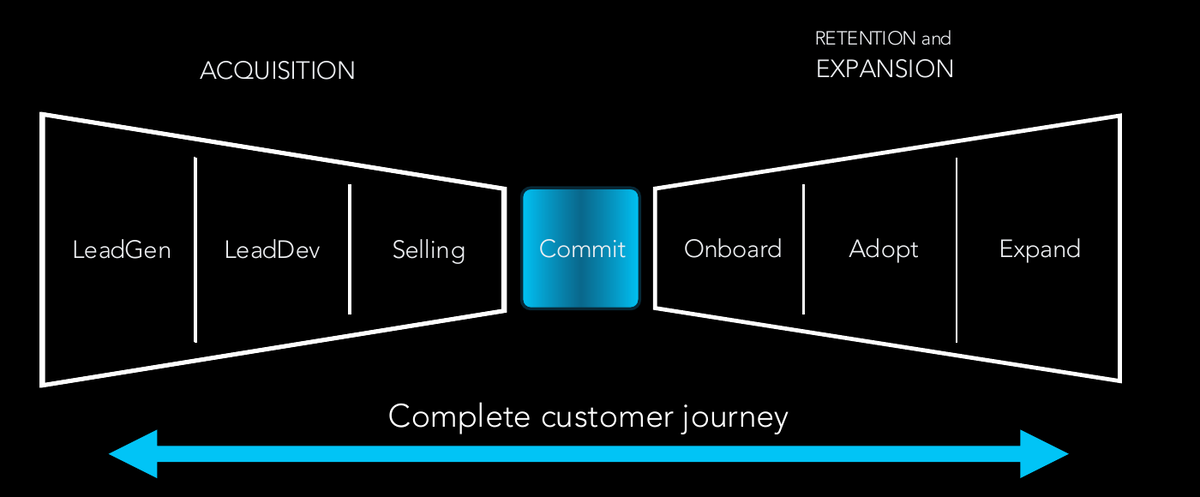
A funnel describes acquisition and stops at the close. In a recurring revenue business that is where the money actually starts, so decisions made on funnel data are made on a partial view. The bowtie extends the journey through onboarding, adoption and expansion, and it gives you the second half where profit lives.
Software then grows along an S curve, the same curve that governs populations, because software propagates the way living things do. A feature is a seed and the user is the pollinator. The consequence is that the exponential middle of that curve has to be sustained for five to ten years, and you cannot sustain it by buying ever more inputs. The inputs run thin and their price goes up.
The mechanism
Five loops, and the two that move pipeline
There are five growth loops worth designing: awareness, education, advocacy, retention and expansion. Expansion is the strongest of them in large enterprise deals and much weaker in high volume SMB, where new businesses appear and disappear at roughly the same rate. For pipeline generation specifically, the work sits in awareness, education and advocacy.
The shift underneath all of it is from leads to users. Traditional growth requires an ever increasing supply of leads, so campaigns must keep expanding to hold the line. Modern growth lets usage create more growth, because users generate impact, impact creates advocacy, and advocacy returns qualified opportunities to the front of the journey.
If you think you have no users, look again at who extracts the impact of what you sell. That person is your user, whatever the contract says.
What the loop is worth
Modeled on a real company with a real lead flow, holding everything else constant:
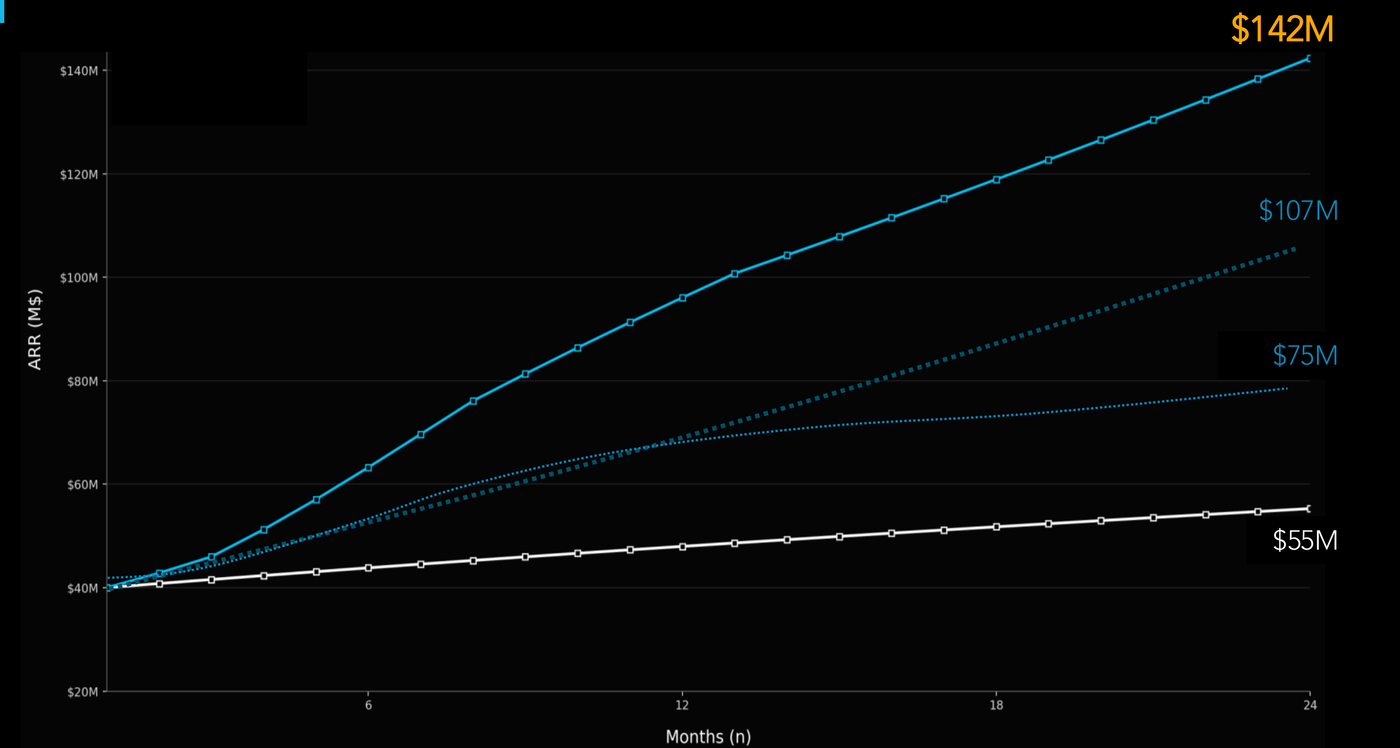
The sensitivity is the part worth sitting with. At one opportunity per hundred users the curve bends. At one per fifty it steepens. At one per twenty five it changes the trajectory of the company. These are not heroic conversion rates. They are the rate at which people who already get value from your product will say so, if you ask them properly.
The proof
Running the model against Harvey
Harvey went from roughly fifty million to three hundred and fifty million in ARR inside twenty four months, selling six figure deals into law firms with buying committees and integration requirements. Not a consumer product, and not a company that could hire its way to that number.
Reconstructing their growth from published figures and running it through the loop model reproduces their reported trajectory within two percent. The model suggests virality created the initial acceleration and advocacy sustained it. Virality created customers, those customers advocated, and advocacy extended the economic life of the original burst.
Look at what that advocacy actually consisted of over four months: a global firm publicizing Harvey powered products, a native integration with a document platform, the first firm launching custom workflows, a strategic alliance, a funding round, a firmwide rollout, then the first rollouts in two more countries, then an adoption milestone, then a law school program. Each event bought the next wave of attention. That is a campaign, not luck.
The work
Designing a campaign that compounds
Making this operational takes four steps, and the third is the one teams skip.
- Identify who can create advocacy. Cohorts, not an ICP slide. A cohort is a group of users who use the product the same way and get the same impact from it, and one customer can contain three of them.
- Design how each cohort gets engaged. What they want, where they already are, what they would find useful enough to open.
- Build an ask ladder. You cannot open with a request for a referral. Small asks earn larger asks, and the ladder is the campaign.
- Activate at scale. Thousands of users, not ten. This is where redeployed SDR capacity does more good than another outbound sequence.
It is worth being honest about what this does not replace. Enterprise committees still buy the way they buy. The claim is narrower: for most software businesses, a designed loop now outperforms another increment of hiring, and almost nobody has built one.
The seller
The X3 seller
Every generation of tooling has produced a new kind of seller. Sequencing tools produced the SDR sending customized email at volume. Video conferencing produced the online seller, and made the conversation recordable, which produced an entire coaching category. The current generation is producing a seller who does roughly three times the work.
Three things define that seller. They do not stop working when they close the laptop, because their agents keep running overnight. They raise quality rather than only volume, which buyers experience as responsiveness, expertise and context. And they work across the whole journey rather than one stage of it, from first touch through expansion.
AI inside go to market runs roughly two years behind AI inside product, and the reason is structural. Product AI operates on a stable base. Go to market is variable, human and messy. That gap is closing now.
The benchmarks
What 253 B2B SaaS marketing leaders are actually doing
Omar Akhtar of Benchmarker presented fresh survey data from 253 senior marketing leaders in US B2B SaaS, fielded in June and July of 2026. The headlines, without the underlying numbers:
- Budgets are not being cut their way to growth anymore. More respondents saw an increase than a decrease, and more expect another next year, with tighter expectations on proving the return.
- Program spend has overtaken people spend. Teams are getting leaner while running more technology and more campaigns, and the people share is the lowest it has been in the years this survey has run.
- Money is moving toward the existing customer base. Lifecycle marketing is up sharply and paid media is down, which is the budget catching up with the advocacy argument above.
- Events are down in total but up in quality. Fewer sponsorships and big bespoke productions, more small rooms like this one. High performing teams spend more on events than everyone else.
- Paid search is losing share. Review sites, AI search visibility and content syndication are gaining, particularly for enterprise sellers who need a portfolio rather than a channel.
- AI is now a standard martech category rather than an experiment, and CRM is the single most named target for cost reduction.
- Forecasts lean heavily on CRM, funnel and dashboard data, while brand, events and external market data are underweighted, which creates a real risk of false precision.
- What is driving the change depends on your size. Smaller companies are balancing growth against efficiency, midsize companies are reinventing the growth model, and the largest are rebuilding the operating model around AI.
Full data, including the segment cuts, went to attendees with the deck.
Where to start
Five stages of go to market maturity
Most teams can place themselves on this ladder in about ten seconds, and the placement tells you what to build next.
The jump that matters is from three to four, and it turns on a decision about what the system is allowed to decide for itself.